:format(webp))
Overcoming Challenges Through Alternative Student Learning Opportunities
In today’s world of education-based athletics, staffing shortages, supply chain delays and budget cuts are familiar challenges facing nearly every athletic administrator. Coaching vacancies are drawing fewer – if any – applicants; buildings and grounds staffing positions remain unfilled; and the turnover rate of athletic administrators is at an all-time high.
In the face of such challenges, creativity and outside-the-box thinking have become a necessity for many school athletic departments to continue to provide the highest quality education-based athletic experiences for students and school communities. Finding solutions to these challenges can be victories within themselves; however, when these creative solutions can contribute to learning opportunities for students, the benefits can be invaluable.
One such creative solution has existed for more than a decade at Bellows Free Academy (BFA) in Fairfax, Vermont. During the past 10 years, the community of Fairfax has experienced significant population growth due to families moving to the area and commuting to employment opportunities in nearby cities. This population boom has greatly increased the school’s student enrollment. However, the school’s facilities, staffing and infrastructure have remained relatively unchanged, leading to an ongoing struggle to meet the needs of the school community, including those of the athletic department.
In light of these challenges, the BFA Fairfax Athletic Department established an internship program for high school students who may need an additional elective course, or for those students who may thrive in a learning environment outside of a typical classroom setting. Through these internships, high school students receive real-world job experience, as well as the ability to demonstrate required graduation proficiencies and transferable skills.
This student learning experience starts initially by shadowing the activities director, then taking part in the day-to-day operations of BFA Fairfax athletics and grounds staff. Student interns perform work in nearly every aspect of athletic operations, with the only exception being administrative requirements involving personal student information that falls under the regulations of the Family Educational Rights and Privacy Act.
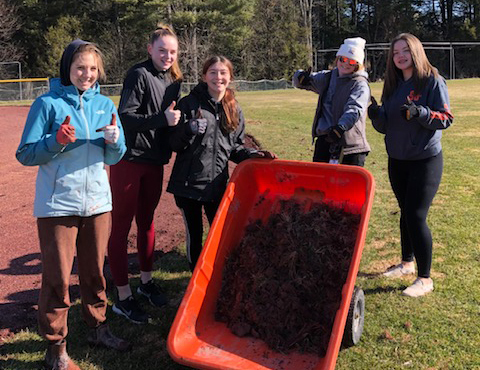
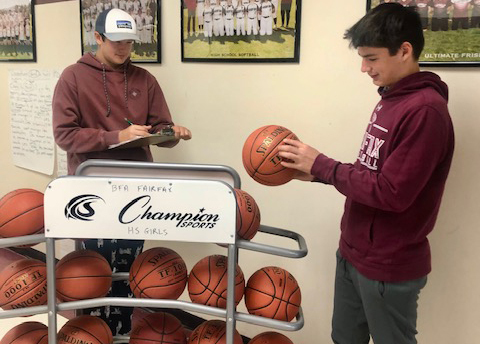
Once the appropriate training is completed by shadowing both the athletic director and the buildings and grounds staff, student interns take part in daily work ranging from administrative tasks to facility upkeep. Administrative work often involves creating event programs, confirming officials, sending out updates to the school community on social media platforms, updating the athletic department page on the school website, maintaining the equipment and uniform inventory, or setting up equipment and essentials needed for home events. With respect to the work that involves the fields, the student interns frequently set up fencing, line fields, assist in seeding or watering the grass areas in the various venues, paint dugouts and benches, and ensure that all audio and scoreboard equipment is in working order for home events.
In all cases, the activities director and the grounds crew thoroughly explain how each task is done, as well as provide supervision as the interns do their work. After the completion of the various responsibilities, the supervisors provide feedback, an expression of thanks, and occasionally a minor correction or two. All of this ensures that the student participants gain practical knowledge, while they grow and develop from the experience.
Since the program’s inception, dozens of high school student interns have successfully contributed to the ever-increasing needs of the BFA Fairfax athletic department. In doing so, not only did the students fulfill graduation requirements, but many applied the skills they learned as interns to their future college or workbased pursuits, including as camp counselors, athletic coaches, collegiate recreation program administrators, town facilities managers, health and physical education teachers, and naturally, education- based athletic and activities administrators.
For some students, the opportunity was simply a unique opportunity to fill out their class schedule for the year. For others, the internship opportunity provided a necessary alternative learning option to assist in earning their high school diploma, and ultimately set them on a path toward their future career.
Taylor Mitchell, 2021 graduate of BFA Fairfax, now a sophomore at Guilford College in Greensboro, North Carolina, shared the following thoughts about the intern experience.
“I learned how to manage my time better, and to see how the various systems in the workplace function,” Mitchell said. “The experience helped me excel at my summer job, and it provided me with skills I’m now using in my business degree.”
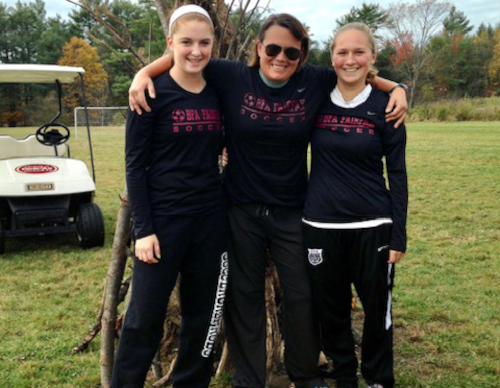
Morgan Young, BFA Fairfax Class of 2013, and current middle school health teacher and junior varsity girls soccer coach in the nearby Colchester School District, served as one of the inaugural student interns in the program. Young reflected on her experience by sharing, “I learned that more goes into a home event or activity than what is perceived. Little details make the whole picture go round. As an intern, I was able to share responsibilities and duties that allowed our athletic director to focus more on the crucial tasks and big picture. More importantly, it gave me a better understanding on how schools function. It also gave me a better perspective what it takes to be a coach and teacher, and the program greatly influenced and laid the groundwork for my path as a health and physical education teacher. And with recently starting my master’s degree in athletic leadership, it helped me be much more confident in my choice of career.”
The challenges facing today’s athletic administrators and their school communities do not appear to be going away any time soon. Unfortunately, there is no magic wand that exists to overcome staffing shortages, budget cuts, population growth, and the multitude of other challenges facing schools. However, with some creativity and outside-the-box thinking, schools can create opportunities that not only provide solutions to imminent challenges, but more importantly, they can also make the ultimate difference in a student’s future.
Related Stories
:format(webp))
:format(webp))
:format(webp))
:format(webp))
:format(webp))
:format(webp))
:format(webp))